History is endlessly fascinating and also complicated and sometimes difficult. It is, after all, the story of humans beings, and humans are complicated, doing great and terrible things often at the same time. The citizens of Brunswick Town were no different. They helped kick off a revolution that led to a nation founded on the ideals of freedom and the notion that all men are created equal. These same people also imported, sold and owned men, women and children.
The Brunswick Town State Historic Site has done a great job telling the first part of that story, and now the second part is getting its due. Last month the Africa To Carolina Inclusive Public Art Initiative was dedicated at Brunswick Town. The installation includes sculpture, two dimensional artwork, and poetry that all tell the story of, and pay homage to, the people who came to Brunswick Town on slave ships and were sold on its docks, worked on its farms and in its homes, and helped build the town.
The monument is found on the path around Brunswick Town next to a pavilion. You won’t miss it — it’s impressive in both size and the quality of the design and artwork. When you visit, be sure to read the plaques under the sculptures. They contain an original poem by North Carolina’s Poet Laureate Jaki Shelton Green that is quite moving.
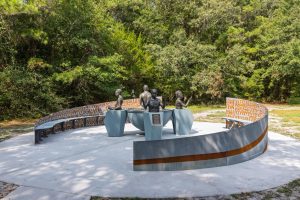 The monument is the work of artists David Wilson and Stephen Hayes. Wilson is a 2-D artist and Hayes a sculptor, and this collaboration is the result of about three years of work. The project was commissioned by the North Carolina African American Heritage Commission with major funding provided by the Z. Smith Reynolds Foundation. By luck I’d met Hayes while stopping by to take photos of the work being installed.
“We had community engagements and stuff, so we work with the community and see about what they’re interested in, and then we come up with our design and present it back to them and see if they like the work,” Hayes explained. “It’s going to be an inviting space to bring people in and to imagine what went on on these ships as they disembark from the water,” he said.
Hayes is an art professor at Duke University and has dedicated his artistic works to honoring and teaching about the contributions and sacrifices of those brought to the Americas as slaves. He has work in several states and in the Caribbean and said his goal is to have a piece at every slave port in the Americas.
He told me he was inspired by what sees as the hidden history of the slave trade. “Just me not knowing much about the transporting of people from Africa to America, and learning it was a six- to eight-week journey for them to be on the boat with no sights, and being able to tell that story and continue to tell a story that’s never been told or that doesn’t get told in history books,” he said.
He said much of this story gets skipped over in textbooks. “We learn about the Civil War, we learn about slavery, but we don’t learn about the exact amount of time or how many ships it took to transport people here. You know, over 15 million people that were transported here.”
A monument like this tells an important story, one that was getting less attention than it deserves at sites like Brunswick Town.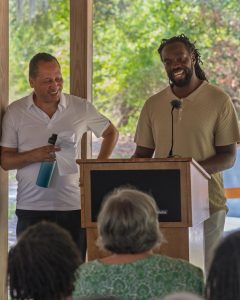
“This is my life’s work,” Hayes said. “To create great artwork that continues to tell the story that’s been untold. So if I can use more artwork as a way of continuing to tell the story, this is what I want to do and that’s my goal to do. You know, I want to be able to set an example for my kids in the next generation to come. I feel like artwork is a thing to connects people across generations or cultures, so if I can create an artwork that’s going to create a conversation between people who are from totally different, you know, walks of life, that’s my job, what I wanna do.”