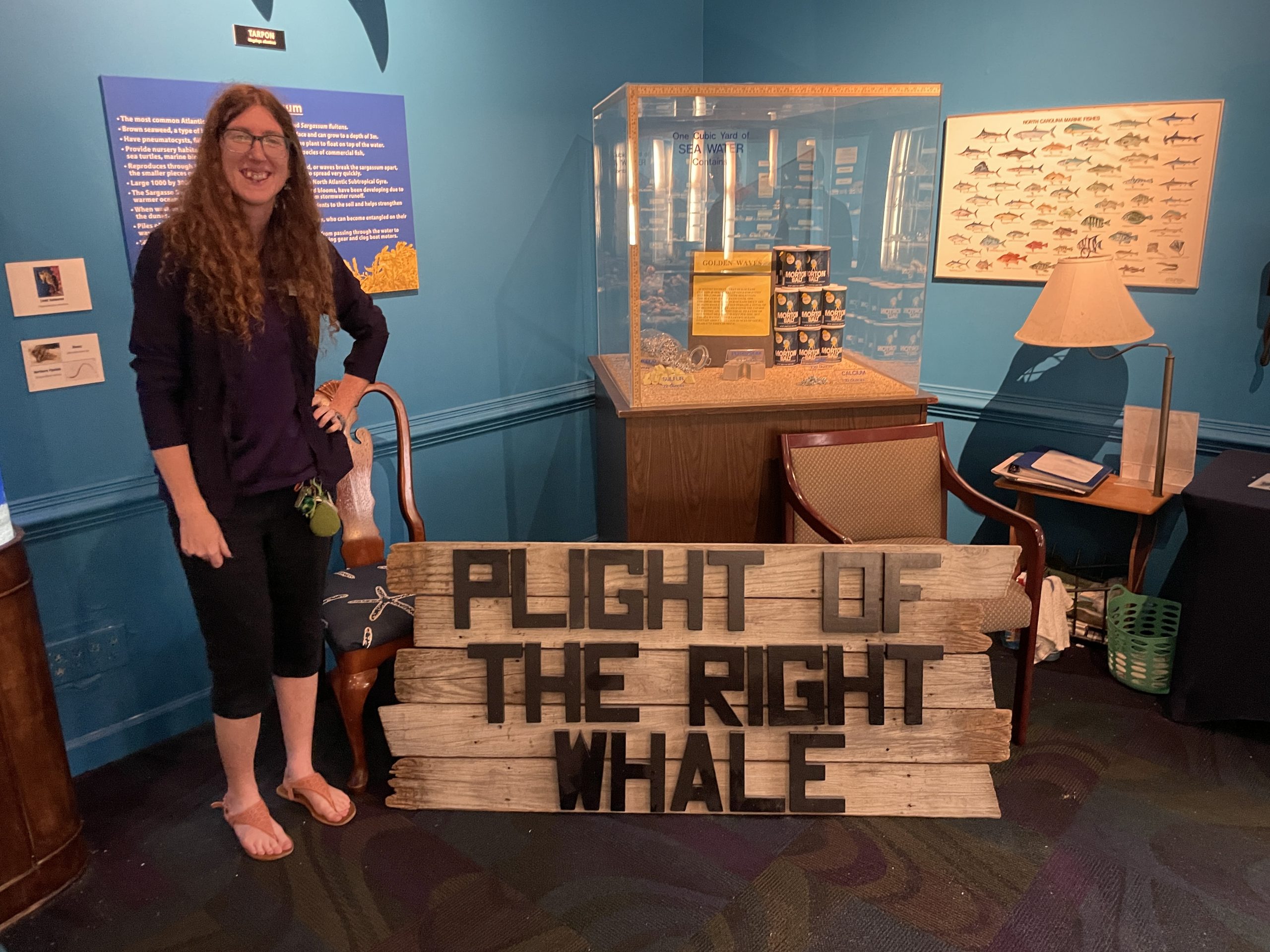
 Bridget Wolf regularly takes her certified therapy dogs to an assisted living facility in Brunswick County to visit with the residents there, and while the dogs bring comfort and joy to the people there, she says it’s something that she looks forward to every week herself.
“I feel like it’s a blanket wrapped around me. It gives me that much comfort,” she said.
Wolf is the founder of Seaside Therapy Dogs, a Brunswick County group of certified therapy dogs and their human counterparts. Each dog works with one person, and dogs are certified through a national organization. When the dogs work though that national organization, though, it’s individually. Wolf said she was looking for a way the teams could work together as a group, and formed Seaside Therapy Dogs approximately two years ago.
One of their first group events was visiting a youth home with nine dogs, and the visit was well received.
“The kids just were so thankful. It’s healing, it’s therapy. It brings them some joy, you know?”
The dogs also regularly visit hospitals and libraries, and they have started doing parades. Many of the dogs also work with the national organization and make visits at airports, helping people deal with anxious situations such as delayed flights or comforting nervous fliers. Bridget also sees potential for dogs to work with funeral homes, and maybe even work with first responders during large-scale events or disasters.
There are more than 20 teams currently involved with the Seaside group, which is based in the Calabash area, but there is room for more. Bridget hopes to do more community outreach and really grow the organization. “We are very active. We really try to get out there and do some good stuff,” she said.
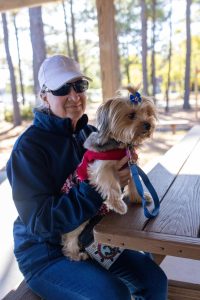
But in the meantime, for Bridget, it’s working with the assisted living facility that pulls at her heartstrings. Bridget has two therapy dogs — Yorkshire Terrier Penny Jane and Fiona, a deaf Labrador.
“The assisted living has changed my life, because at the airport it’s people that come through that I never probably see again — you know, kids at night might be scared or need a distraction. The assisted living that I primarily go to, I’ve gotten to know them. They’re like family to me now,” She said the feedback she gets about the visits is that she and her dogs are welcomed like family too, like the patients feel like they’re not forgotten anymore. “I’ve come to know them, and I’ve come to understand that I’m also aging, right, and that it’s important. Some of these people don’t have anybody come see them. And they’re just in their room, you know? So to me, there’s such a need and it’s beneficial to everybody, to the dogs, to their handlers, and to the residents,” she said.
 During another visit to an assisted living facility with memory care patients, Bridget said there were about 30 people in a circle, ready for the visit. She was working with another group, training, and there were four dogs with them that day.
“We kind of went by and said hi to everybody, and there was this lady that just wasn’t awake. She was kind of in her chair, looking down, and, you know, it was obvious that she wasn’t really aware of what was going on. So this dog kept wanting to go say hi to her. They’re intuitive. I know that they are. This dog wanted to go say hi, and she’s constantly kind of pulling me that way,” she recalled. A nurse told Bridget that the lady wouldn’t speak to them, so she took Penny Jane over in her stroller. Using the stroller makes it easier for people to reach Penny Jane without having to bend over.
“So I finally went over there, and I just stood by the lady. And soon, the lady kind of lifted up her hand, and she just started to stroke the dog. Then, all of a sudden, she started talking about her life, and she hadn’t spoken for months. So that’s the kind of healing power these guys have. You know, I truly believe that they are incredible beings, and I think that they’re the best thing that God gave us,” Bridget said.
Dogs hey have so many abilities with detection for diabetes, seizures, bombs and drugs. They’re also very friendly and often just want to be the life of the party, she said.
Penny Jane is one of those dogs. She is curious, friendly and loving. And when she has had enough stimulation, she lies down in her stroller for a rest.
“She really has a lot of stamina. I do airport visits maybe two hours at a time, but then when she’s out, she’s out,” she said. “And then she just falls asleep, and it’s time to go. When you’re done, she’s emotionally exhausted. It’s exhausting for me too because in that environment, you have so much going on, and there are always safety issues. We’re always really conscious about who is around us. If there’s a child coming up, running, things like that, because we want to make sure everybody’s safe.”
Besides training her own dogs, Wolf evaluates dogs, trains dogs, and tests them for certification.
Dogs have to be the right fit for this kind of work, and when people ask her if they can get involved with their dog, Bridget says that it’s really up to the dog.
“If you have a dog that absolutely loves people, wonderful. You have a good start,” she said. She then finds out more about the dog’s manners, like if the dog jumps on people, which wouldn’t work for a dog dealing with elderly people or children.
“But you can always train the behavior,” Bridget said. “As long as they’re super friendly, you can train the behavior for the most part. They have to be able to get along with other dogs. They have to keep three to four feet apart, but they have to be able to be in the presence of other dogs and not overreact.
“So if your dog is socialized, that’s not a big deal. If your dog hasn’t been socialized, it can become a problem. So they have to be friendly, somewhat socialized, learn some manners. walk nicely on a leash…,” she explained.
The requirements are pretty basic so that people and the dogs are safe.
While a minimum number of visits may be required with some organizations, with Seaside, teams can decide how much they want to participate.
“Group events are probably once every month and a half or so, maybe once every two months. If you want to come great, if you don’t, there’s no requirement,” she said.
“With [Penny Jane], she goes about three times a month with my lab that I’m training, who goes probably three times a week. We’re always at the assisted living,” she said.
“I mean, somebody that’s upset, they can just pet on these dogs and it changes their whole day,” she said.
To find out more about Seaside Therapy Dogs, or to see if you’d like to get involved, contact Bridget at bwolfsfinepaw@gmail.com or at 910-258-9451.